

FD vs SIP vs Mutual Fund: Which is better for your money? Compare returns, risks, tax benefits, and best uses to choose the right investment strategy.
In today’s fast-paced world, earning money is important—but knowing where to invest it wisely and managing risk for better returns is even more crucial. Whether you’re a salaried professional, a retiree, or a new investor, the common dilemma remains: Fixed Deposit (FD) vs Mutual Fund vs SIP – which one is better?
In this guide, we will break down the key differences, compare returns, risks, liquidity, and tax benefits, and help you align your investment with your financial goals.
What Are FD, Mutual Fund, and SIP?
| Investment Type | Description |
|---|---|
| Fixed Deposit (FD) | A traditional savings option where a lump sum is deposited with a bank or NBFC for a fixed tenure at a fixed interest rate. Offers capital safety and guaranteed returns. |
| Mutual Fund | A pooled investment vehicle managed by professionals, which invests in stocks, bonds, or other securities based on the fund’s objective. Returns are market-linked. |
| Systematic Investment Plan (SIP) | A method of investing small, fixed amounts regularly (monthly, weekly, etc.) into mutual funds. Helps build wealth gradually and benefits from cost averaging over time. |
Note
SIP is a method of investing in mutual funds, not a standalone investment product. However, it is often discussed separately due to its popularity.
Returns: What Can You Expect?
| Investment Type | Average Annual Returns | Inflation Beater? |
|---|---|---|
| Fixed Deposit | 6% to 7.5% | Generally No |
| Mutual Fund (Lump Sum) | 10% to 14% | Yes |
| SIP in Mutual Funds | 10% to 14% | Yes |
FDs are predictable but usually fail to outpace inflation. Mutual Funds and SIPs, especially in equity schemes, tend to offer significantly higher returns over the long term.
Risk Comparison
| Investment Type | Risk Level | Details |
|---|---|---|
| Fixed Deposit | Very Low | Principal and interest are guaranteed; no market exposure. |
| Mutual Fund | Moderate to High | Returns depend on market performance; potential for high gains and losses. |
| SIP | Moderate | Long-term SIPs in equity funds reduce volatility risk through rupee cost averaging. |
Fixed Deposits offer safety. Mutual Funds offer higher growth potential. SIPs offer a balance through disciplined long-term investing.
Liquidity: How Easily Can You Access Your Money?
| Investment Type | Liquidity | Details |
|---|---|---|
| FD | Medium | Premature withdrawal possible with penalty or lower interest. Not ideal for emergency funds. |
| Mutual Funds | High | Most open-ended funds can be redeemed within 1–3 working days. ELSS funds have a 3-year lock-in. |
| SIP | High | You can pause or stop SIPs at any time. Units can be redeemed anytime unless invested in ELSS. |
For flexibility and emergency access, Mutual Funds and SIPs are better options than FDs.
Tax Efficiency
Fixed Deposit
- Interest is fully taxable under your income slab.
- TDS is deducted if interest exceeds ₹40,000 (₹50,000 for senior citizens).
- If you’re in the 30% slab, your effective return on a 7% FD is only about 4.9%.
Equity Mutual Funds
- Short-Term Capital Gains (STCG): Taxed at 20% if held for less than 1 year.
- Long-Term Capital Gains (LTCG): Tax-free up to ₹1 lakh per year. Beyond that, taxed at 12.5%.
Example:
Invest ₹2,00,000 → Redeem after 2 years for ₹3,40,000
Gain = ₹1,40,000 → ₹1,00,000 tax-free → Tax = 12.5% of ₹40,000 = ₹5,000
Debt Mutual Funds (Post-April 2023)
- Gains taxed as per your income slab, irrespective of holding period.
- No indexation benefit on long-term gains.
SIPs
- Taxed the same way as the underlying mutual fund (equity or debt).
- Each SIP installment is treated as a separate investment with its own holding period.
Who Should Choose What?
| Investor Type | Recommended Option |
|---|---|
| Conservative or Retired | Fixed Deposit |
| Salaried & Goal-Oriented | SIP in Mutual Fund |
| Long-Term Growth Seeker | Equity Mutual Fund (Lump Sum) |
| Tax-Saving Focused | SIP in ELSS Fund |
| First-Time Investor | SIP in Balanced Mutual Fund |
What Is an ELSS Fund?
ELSS (Equity Linked Saving Scheme) is a type of mutual fund that:
- Invests primarily in equities (80% or more)
- Offers tax deduction under Section 80C (up to ₹1.5 lakh annually)
- Has a mandatory 3-year lock-in period
- Gains over ₹1 lakh are taxed at 10% as LTCG
ELSS is ideal for long-term tax-saving goals like retirement or children’s education.
Quick Summary Table
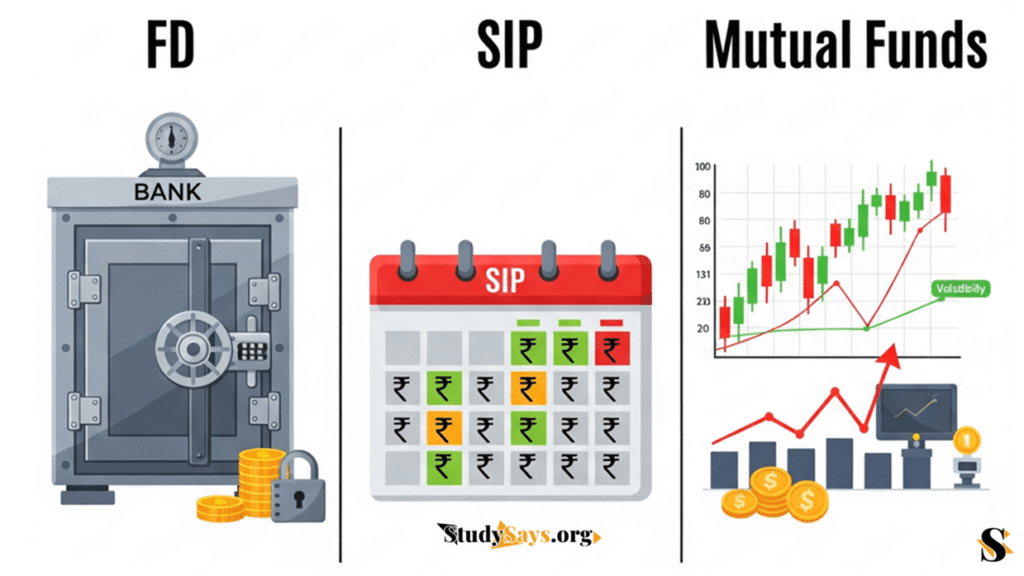
| Feature | Fixed Deposit | Mutual Fund | SIP |
|---|---|---|---|
| Returns | 6%–7.5% | 10%–14% | 10%–14% |
| Risk | Very Low | Moderate to High | Moderate |
| Liquidity | Medium | High | High |
| Tax Benefits | Low | High (ELSS) | High (ELSS) |
| Best For | Short-term savings | Long-term growth | Consistent wealth building |
Conclusion: The Smart Way to Invest
There’s no single winner—because the right investment depends on your goals, risk appetite, and timeline.
- Choose FDs if you value safety, fixed returns, and capital protection. Ideal for short-term savings and retirees.
- Go for Mutual Funds (via lump sum) if you’re aiming for higher returns and can tolerate market fluctuations.
- Start with SIPs if you want to build wealth gradually through monthly discipline, especially for long-term goals like retirement or buying a house.
Smart investors don’t pick one—they combine all three:
- Use FDs for emergency or near-term needs,
- Use SIPs for consistent long-term growth,
- Use lump sum mutual funds when you have extra money to grow.
Your money should work for you, not just sit in a savings account. Choose wisely, stay consistent, and let compounding do its magic.